


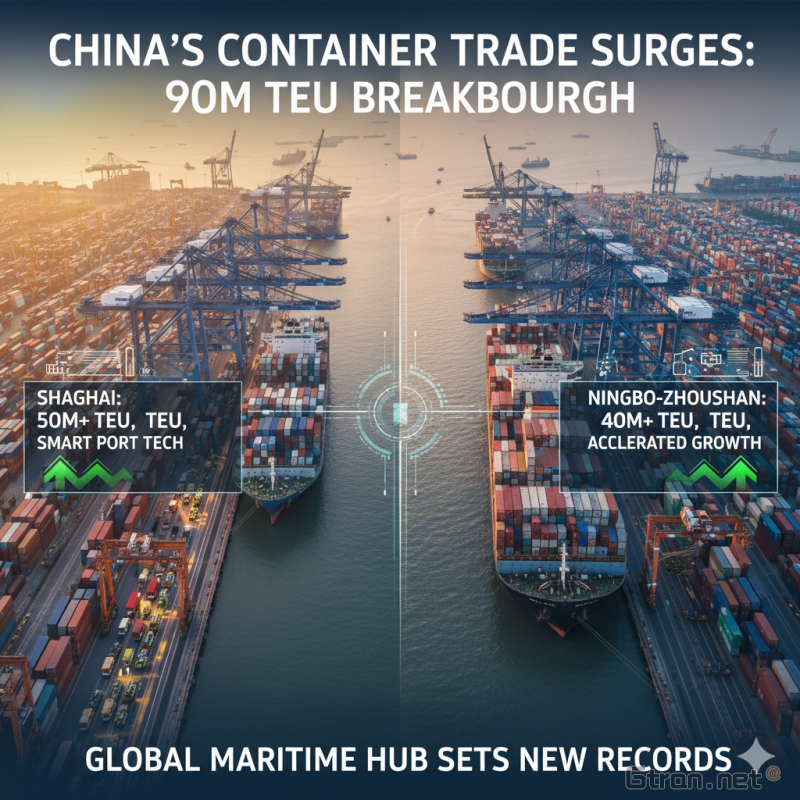
Shanghai & Ningbo, China – Despite a year marked by global trade volatility and logistical challenges, China's container volumes continue their relentless upward trajectory. Two of the nation's premier port complexes, Shanghai and Ningbo-Zhoushan, have set astonishing new records, collectively handling over 90 million TEU in the first 11 months of 2025, underscoring China's enduring dominance in global maritime trade.
Shanghai Port: 16 Years at the Top, Breaking 50M TEU Barrier Early
The Port of Shanghai, consistently ranked as the world's busiest container port for 16 consecutive years, has once again surpassed the 50 million TEU mark. This achievement, reached on November 26, is a significant milestone, approximately one month ahead of last year's pace. While full-year forecasts remain undisclosed, Shanghai Port is on track to easily exceed its 2024 record of 51.5 million TEU, maintaining an average of over 4 million TEU monthly this year.
Port management attributes this sustained growth to a strategic shift from physical expansion to a holistic operational restructuring. The port now functions as a single, synchronized entity, integrating its highly automated main port with legacy upriver terminals. This integration is powered by cutting-edge port technology, including remote-controlled cranes, autonomous yard vehicles, and AI-driven planning tools. A central integrated port management and control system acts as the "nervous system," optimizing equipment allocation, sequencing operations, and balancing capacity in real-time. Innovations like digital twins, high-precision positioning, and F5G networks are now integral to daily operations, with AI supervision streamlining processes that once required extensive human intervention. This focus on smart port solutions is key to its future growth and efficiency.
Ningbo-Zhoushan Port: Accelerating Growth, First to Hit 40M TEU
Equally impressive is the meteoric rise of the Ningbo-Zhoushan Port in eastern China, which achieved its own historic milestone on December 2, handling its 40 millionth TEU in 2025. This marks the first time the port has reached this volume, surpassing its entire 2024 total of approximately 39.3 million TEU.
Ningbo-Zhoushan's growth trajectory is rapidly accelerating. A relatively newer entrant compared to Shanghai, it took seven years to grow from 10 to 20 million TEU, then six more to reach 30 million TEU. However, it achieved the 40 million TEU mark in just four years, demonstrating its increasing significance in global trade. Beyond containers, Ningbo-Zhoushan proudly asserts its status as the only port globally to handle over 1 billion tonnes of total cargo annually for 16 consecutive years, solidifying its position as a major shipping hub.
The port complex boasts a vast global network, connected to over 300 container shipping routes serving 600 ports in 200 countries and regions. Its infrastructure includes over 210 berths for ships above 10,000 tons, with 135 dedicated to vessels exceeding 50,000 tonnes, showcasing its capacity to handle the largest container ships.
This combined record-breaking performance by Shanghai and Ningbo-Zhoushan underscores China's unwavering commitment to enhancing its maritime logistics infrastructure and its pivotal role in facilitating global trade flows. The integration of advanced port automation and AI in logistics is clearly driving unprecedented efficiency and volume, setting new benchmarks for the international shipping industry.


