


GT Global Transportation Network News | Air Cargo Market Update
The global air freight market entered August with signs of moderation as cargo volumes declined and pricing levels softened after a period of stronger activity. According to the latest analysis from WorldACD, worldwide air cargo demand weakened during the first full week of August, with chargeable weight declining across major origin regions while carriers adjusted capacity in response to changing market conditions.
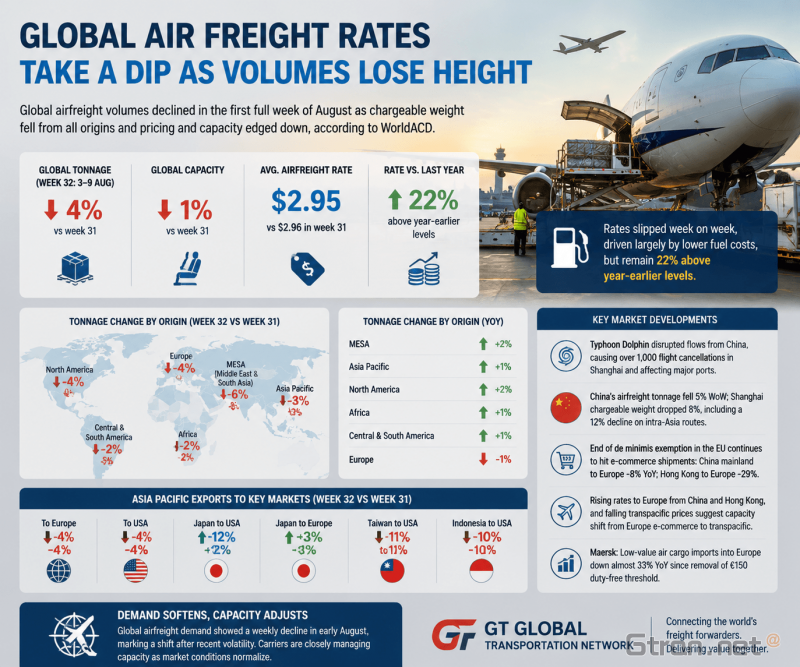
Global airfreight tonnage fell by 4% week on week during week 32 (3–9 August), following a temporary recovery in the previous period. The decline was recorded across most major regions, including a 6% decrease from the Middle East and South Asia (MESA), a 4% reduction from Europe and North America, and a 3% decline from Asia Pacific.
Despite the short-term slowdown, the overall market remains stronger compared with the previous year. Global air cargo traffic was still approximately 1% higher year on year, with most regions reporting modest annual growth. The latest figures indicate that the market is moving into a more balanced phase after several months of fluctuating demand.
For freight forwarders and global logistics providers, the current environment highlights the importance of flexible capacity management, accurate forecasting, and close monitoring of trade flows.
Air Freight Demand Loses Momentum After Strong Earlier Performance
WorldACD noted that global air cargo activity has fluctuated within a relatively narrow range in recent weeks, alternating between periods of growth and contraction. Compared with the previous two-week period, global chargeable weight declined by around 1%, mainly driven by weaker volumes from Asia Pacific and North America.
The moderation in demand reflects several market factors, including changes in consumer behavior, evolving trade patterns, and adjustments in inventory strategies.
During previous months, businesses accelerated shipments due to uncertainty surrounding trade policies, potential tariff changes, and supply chain risks. This front-loading effect supported air cargo demand earlier in the year but may reduce additional peak-season growth later in the year.
Air Freight Rates Remain Elevated Despite Recent Decline
Alongside weaker volumes, global air freight capacity also decreased slightly, falling by approximately 1% week on week.
The average global air freight rate declined marginally from USD 2.96 per kilogram in week 31 to USD 2.95 per kilogram in week 32, mainly due to lower fuel costs. However, rates remain significantly above last year’s levels, with prices still approximately 22% higher year on year.
The continued strength in pricing demonstrates that although demand has softened, the air cargo market remains supported by limited capacity availability, ongoing supply chain adjustments, and strong demand for time-sensitive shipments.
Asia Pacific Export Market Faces Mixed Performance
Asia Pacific remains one of the most important regions for global air cargo flows, but recent performance has been uneven.
Exports from Asia Pacific to Europe and the United States both declined by 4% week on week. However, some markets showed stronger performance. Japan recorded a 12% increase in air cargo volumes to the United States and a 3% increase to Europe.
Other Asian export markets experienced weaker conditions, with Taiwan’s shipments to the United States declining by 11% and Indonesia’s volumes falling by 10%.
China’s air cargo market was also affected by operational disruptions. Typhoon Dolphin caused significant disruption to transportation networks, including airport closures, flight cancellations, and impacts on regional logistics operations.
China’s overall air freight tonnage declined by 5% week on week, while Shanghai experienced an 8% reduction in chargeable weight, including a 12% decline in intra-Asia shipments.
These disruptions demonstrate how weather events and regional infrastructure challenges can quickly influence international cargo flows.
E-Commerce Changes Reshape Europe-Bound Air Cargo Demand
Another important factor affecting air freight patterns is the changing landscape of cross-border e-commerce shipments.
Following the removal of the European Union’s €150 duty-free threshold for low-value imports, e-commerce-related air cargo volumes have declined significantly.
According to industry updates from Maersk, low-value air cargo imports into Europe have fallen by nearly one-third year on year following the policy change. This reflects a broader shift away from high-volume, low-value e-commerce shipments toward higher-value and more specialized cargo categories.
WorldACD also reported weaker Europe-bound volumes from major Asian export markets, with mainland China to Europe shipments declining year on year and Hong Kong to Europe volumes experiencing a sharper reduction.
As e-commerce air cargo demand decreases, some freighter capacity previously allocated to Europe-bound shipments may be redirected toward other trade lanes, particularly the transpacific market.
Freight Forwarders Must Adapt to Changing Air Cargo Dynamics
The latest market developments highlight the increasingly complex environment facing air freight professionals.
Freight forwarders are required to manage multiple challenges, including:
Changing customer demand patterns
Regional transportation disruptions
Capacity availability fluctuations
Cost management pressures
Shifting global trade flows
To remain competitive, logistics providers are focusing on stronger carrier partnerships, diversified routing options, digital shipment visibility, and proactive customer communication.
The ability to quickly adjust transportation solutions has become a key advantage in today's global logistics market.
Outlook: A More Balanced Air Cargo Market Ahead
While global air freight demand has softened in recent weeks, the market remains supported by relatively strong pricing compared with previous years.
Future conditions will depend on several factors, including consumer demand, global economic activity, trade policies, fuel costs, and potential disruptions affecting major logistics hubs.
For freight forwarders and supply chain operators, continued market monitoring and flexible planning will be essential as the industry moves through the second half of the year.
GT Global Transportation Network will continue tracking developments across air cargo, ocean freight, and international logistics markets to provide valuable insights for freight forwarding professionals worldwide.
As global trade continues to evolve, the ability to adapt quickly and build resilient logistics solutions will remain the foundation of success in the international transportation industry.


