


GT Global Transportation Network News | Ocean Shipping & Global Trade Update
The global container shipping industry is closely monitoring the gradual return of vessels to the Suez Canal as major carriers reassess route strategies following months of disruption and uncertainty in the Red Sea region.
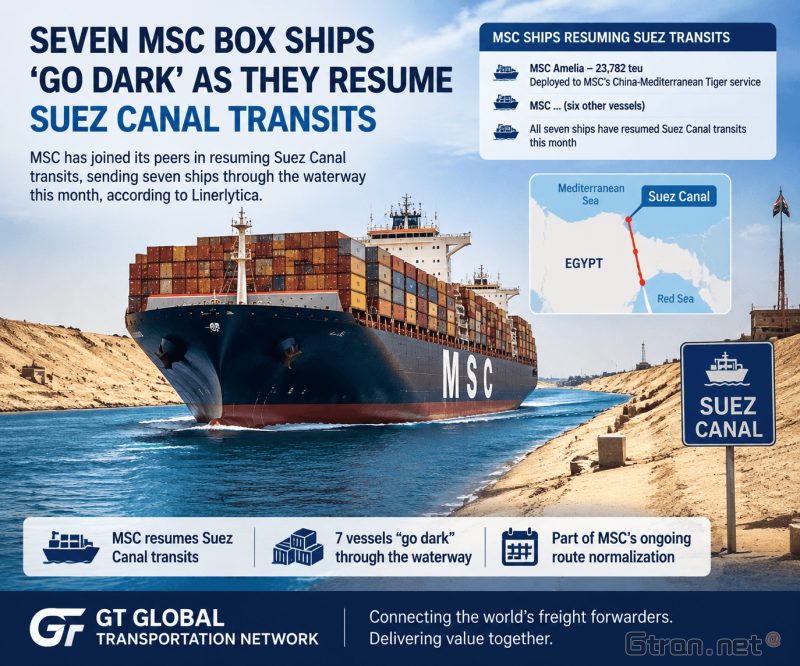
Mediterranean Shipping Company (MSC), the world’s largest container shipping line by operated capacity, has resumed Suez Canal transits, with seven MSC container vessels reportedly passing through the strategic waterway this month, according to container shipping consultancy Linerlytica.
The development marks another important step toward the potential normalization of Asia–Europe shipping routes, although carriers continue to evaluate operational risks and maintain flexible deployment strategies.
The Suez Canal remains one of the most critical maritime passages in global trade, connecting the Indian Ocean and Red Sea with the Mediterranean Sea. Any disruption to this route can significantly affect transit times, vessel schedules, fuel consumption, and global supply chain costs.
For freight forwarders and logistics providers worldwide, the gradual restoration of Suez Canal operations could bring improvements in schedule reliability and transportation efficiency across major trade lanes.
MSC Joins Industry Shift Toward Suez Route Recovery
According to Linerlytica’s latest market analysis, MSC has joined other major container carriers in resuming selected Suez Canal transits after previously adjusting networks to avoid regional security risks.
Among the vessels identified was the 23,782 TEU MSC Amelia, operating on MSC’s China–Mediterranean Tiger service, which completed a Suez Canal transit as part of its regular Asia–Mediterranean network.
The return of large container vessels through the waterway demonstrates that shipping companies are actively evaluating the balance between operational efficiency and security considerations.
For carriers, using the Suez Canal provides significant advantages compared with longer alternative routes around the Cape of Good Hope, including:
Shorter sailing distances between Asia and Europe
Reduced fuel consumption
Lower vessel operating costs
Improved schedule efficiency
Better utilization of available fleet capacity
However, carriers continue to closely monitor regional developments before making long-term commitments to full-scale route restoration.
Suez Canal Remains Essential to Global Supply Chains
The Suez Canal handles a substantial share of global container traffic and serves as a key connection between major manufacturing regions in Asia and consumer markets in Europe.
When vessels avoid the canal and reroute around Africa, voyages become significantly longer, increasing transportation costs and reducing effective global vessel capacity.
The previous disruption created several challenges for the logistics industry, including:
Longer transit times between Asia and Europe
Increased fuel consumption and emissions
Schedule reliability issues
Equipment imbalances at major ports
Higher operational costs for carriers and shippers
The gradual return of vessels to the canal may help reduce some of these pressures and improve efficiency across international supply chains.
Impact on Freight Forwarders and Global Logistics Planning
For freight forwarding companies, changes in carrier routing strategies have a direct impact on shipment planning and customer solutions.
A more stable Suez Canal route could provide opportunities for:
More predictable Asia–Europe transit schedules
Improved cargo planning accuracy
Reduced dependence on alternative routing options
Better control of transportation costs
However, logistics providers must continue maintaining contingency plans as global shipping remains exposed to geopolitical, weather, and operational risks.
The recent years have demonstrated that flexibility has become a core requirement in international logistics. Freight forwarders increasingly need access to multiple routing options, strong carrier relationships, and real-time market intelligence.
Carriers Continue Balancing Efficiency and Risk Management
While the return of MSC vessels represents a positive development, carriers are expected to remain cautious in their network decisions.
Shipping companies must consider several factors when determining route strategies, including:
Regional security conditions
Insurance costs
Customer service expectations
Vessel availability
Global capacity management
The container shipping industry has already experienced significant network adjustments in response to previous disruptions, and carriers are likely to adopt a gradual approach rather than immediately returning all services to previous patterns.
Outlook for Asia–Europe Container Trade
The resumption of Suez Canal transits by MSC and other carriers suggests growing confidence in the stability of one of the world’s most important shipping corridors.
If more vessels continue returning to the route, the industry could see improved efficiency and reduced pressure on global vessel capacity. However, market participants will continue monitoring developments closely as geopolitical conditions remain an important factor influencing maritime operations.
For members of GT Global Transportation Network, understanding these changes is essential for supporting customers with reliable and competitive international logistics solutions.
GT Global Transportation Network will continue following developments in ocean shipping, carrier strategies, port operations, and global supply chain trends to provide timely insights for freight forwarding professionals worldwide.
As global trade continues to evolve, resilient logistics networks and strong international cooperation will remain key drivers of success in the freight forwarding industry.


