


GT Global Transportation Network News | Ocean Shipping & Fleet Strategy Update
The global container shipping industry is undergoing a major structural transformation as leading carriers increasingly shift from chartered vessel dependence toward owning more of their fleet capacity. According to the latest analysis from Sea-Intelligence, the world’s 12 largest container lines have significantly expanded their owned vessel share, with owned tonnage now accounting for nearly two-thirds of their operated fleets.
The development marks a substantial change in fleet strategy. The proportion of owned vessels among the top global carriers increased from 43% in January 2020 to approximately 63% by March 2025, reflecting a long-term move toward greater fleet control, capacity security, and operational flexibility.
The analysis covers the world’s leading container shipping companies, including MSC, Maersk, CMA CGM, COSCO Shipping, Hapag-Lloyd, ONE, Evergreen, HMM, ZIM, Yang Ming, Wan Hai, and PIL.
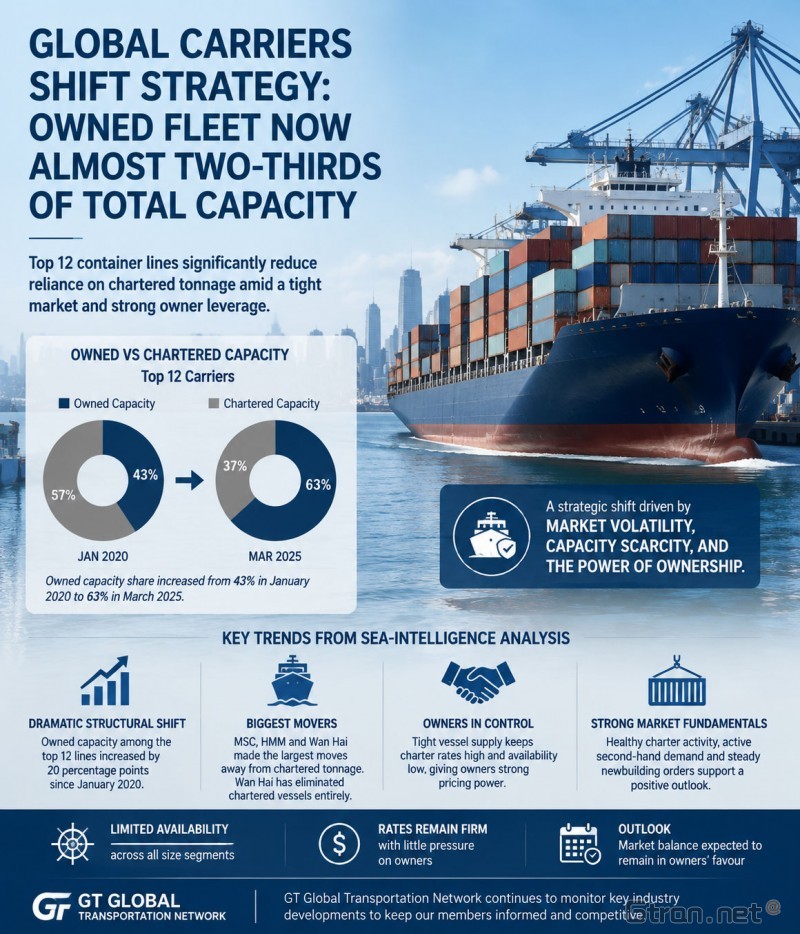
Shipping Lines Prioritize Fleet Ownership Amid Market Uncertainty
The shift toward owned vessels accelerated following several years of significant disruption across global supply chains. From pandemic-related congestion and capacity shortages to geopolitical uncertainty and changing trade patterns, container carriers have faced a market environment where access to reliable vessel capacity has become a key competitive advantage.
Sea-Intelligence data shows that the average chartered vessel ratio among major carriers declined gradually between 2020 and early 2025, before accelerating further in recent months. The trend reflects a strategic decision by carriers to reduce exposure to charter market volatility and secure long-term fleet availability.
Ownership of vessels provides shipping companies with greater control over capacity planning, network deployment, and cost management. In periods of limited vessel availability, owning ships can offer a significant advantage by allowing carriers to maintain service reliability while competitors face charter constraints.
MSC, HMM and Wan Hai Lead the Ownership Transition
Among major carriers, MSC, HMM, and Wan Hai have made some of the most significant adjustments to their fleet structures.
Wan Hai has made the most dramatic transition, eliminating chartered vessels from its operated fleet entirely, while MSC, CMA CGM, Evergreen, and PIL have substantially reduced their reliance on chartered tonnage.
Meanwhile, several major carriers, including Maersk, COSCO Shipping, and ZIM, have made more limited adjustments to their ownership mix, maintaining a more balanced approach between owned and chartered capacity.
The different strategies highlight how global carriers are adapting their fleet models based on business priorities, market conditions, and long-term growth objectives.
Tight Charter Market Supports Vessel Owners
The move toward fleet ownership comes at a time when the container charter market remains strongly favorable for vessel owners.
Market analysts have reported that vessel availability continues to be extremely limited across many ship sizes, with prompt and forward charter positions remaining scarce. As a result, owners have maintained strong negotiating power and continued to achieve firm charter rates.
Recent charter fixtures demonstrate continued demand for available tonnage, particularly in feeder and mid-size container vessel segments. Limited open capacity, combined with strong operational requirements from carriers, has kept charter market conditions supportive for owners.
The second-hand vessel market has also remained active, with buyer interest exceeding available supply. Despite strong demand, limited vessel availability has restricted transaction volumes as shipping companies and investors compete for suitable tonnage.
Newbuilding Investment Reflects Long-Term Confidence
Alongside fleet acquisition strategies, newbuilding activity remains an important part of carrier expansion plans.
Investment in new vessels, particularly in smaller feeder segments, reflects confidence in future container trade demand and the need to modernize aging fleets. Industry observers expect carriers to continue focusing on fuel efficiency, operational flexibility, and compliance with evolving environmental regulations when placing new vessel orders.
As shipping companies continue to strengthen their owned fleets, the global container shipping sector is moving toward a model where strategic asset ownership plays a more important role in maintaining competitiveness.
Implications for Freight Forwarders and Global Supply Chains
For freight forwarders, logistics providers, and international trade partners, the increasing focus on vessel ownership represents a significant shift in carrier behavior.
A stronger owned fleet structure may provide carriers with:
Greater capacity stability during periods of market disruption
Improved schedule reliability through enhanced operational control
More predictable network planning across global trade lanes
Stronger investment in long-term service capabilities
However, continued fleet expansion and vessel ownership may also influence future market dynamics, including capacity management, freight rate strategies, and carrier competitiveness.
Building Resilient Global Logistics Networks
The container shipping industry is entering a new phase where fleet ownership, digital transformation, sustainability, and operational resilience are becoming central pillars of long-term strategy.
The rapid increase in owned vessel capacity among leading carriers demonstrates how companies are adapting to a more complex global logistics environment. For members of the GT Global Transportation Network, understanding these market shifts is essential for developing stronger partnerships, optimizing transportation solutions, and supporting customers worldwide.
GT Global Transportation Network will continue monitoring key developments in ocean shipping, freight forwarding, and global supply chain management to provide industry insights and support collaboration across the international logistics community.


