


GT Global Transportation Network News | Air Freight Market Update
The global air freight market is entering a period of adjustment as demand gradually slows following the peak summer shipping season, but air cargo rates continue to demonstrate stronger-than-expected resilience due to tighter capacity conditions and rising operational costs.
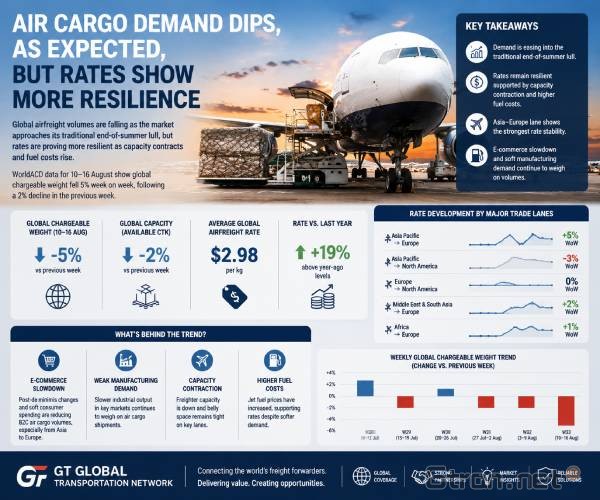
According to the latest WorldACD market data covering 10–16 August, global airfreight chargeable weight declined by 5% week on week, following a 2% decrease in the previous week. The decline reflects the traditional end-of-summer slowdown, when many markets experience reduced cargo activity before the next seasonal demand cycle begins.
Despite weaker volumes, pricing has remained relatively stable. Limited capacity growth, higher fuel expenses, and ongoing uncertainty in global trade flows have prevented rates from falling at the same pace as demand.
For freight forwarders, airlines, and global logistics providers, the latest market conditions highlight a more balanced but complex air cargo environment where capacity management and demand forecasting remain critical.
Air Freight Demand Enters Seasonal Adjustment Period
The decline in global air cargo volumes is consistent with seasonal market patterns. After stronger activity during earlier months, air freight demand typically softens toward the end of summer as consumer and manufacturing activity adjusts.
However, the current market is also being influenced by broader economic and trade factors, including:
Slower consumer demand in some major markets
Reduced e-commerce air cargo growth
Manufacturing uncertainty in key export regions
Changes in inventory strategies among global businesses
While demand has weakened, the market remains more stable compared with previous downturn cycles. Air cargo volumes continue to benefit from specific sectors requiring fast and reliable transportation, including electronics, pharmaceuticals, high-value goods, and urgent industrial components.
Capacity Reduction Supports Air Freight Rates
Although cargo volumes declined, available air freight capacity has also contracted, helping support pricing levels.
WorldACD data indicates that available capacity decreased during the same period, limiting downward pressure on freight rates. The average global airfreight rate remains significantly higher than last year, demonstrating that the market continues to operate under tighter conditions compared with historical levels.
Several factors are contributing to rate resilience:
Reduced freighter availability on certain trade lanes
Higher aircraft operating expenses
Fuel cost fluctuations
Strong demand for specialized cargo services
The combination of softer demand and controlled capacity has created a market environment where rates are adjusting gradually rather than experiencing a sharp decline.
Asia-Europe Air Cargo Flows Face Continued Pressure
Asia remains a key driver of global air cargo demand, but recent trends show uneven performance across major trade lanes.
Air cargo flows from Asia to Europe have been affected by changing e-commerce patterns, especially following regulatory changes affecting low-value imports. Reduced e-commerce volumes have changed traditional air cargo demand structures, with carriers and forwarders adjusting capacity deployment accordingly.
At the same time, certain high-value shipments continue to support demand, particularly in sectors requiring speed, reliability, and supply chain flexibility.
The shift demonstrates a broader transformation in air logistics, where cargo composition is becoming increasingly important in determining market performance.
Global Trade Uncertainty Shapes Air Freight Strategies
The air cargo industry continues to operate in a challenging global environment influenced by geopolitical developments, economic uncertainty, and changing trade policies.
Businesses are increasingly reviewing transportation strategies to improve supply chain resilience. Many companies are adopting a more flexible approach by combining air, ocean, and multimodal solutions depending on urgency, cost considerations, and market conditions.
For freight forwarders, this creates opportunities to provide greater value through:
Alternative routing solutions
Customized air freight strategies
Real-time market intelligence
Strong airline partnerships
Integrated multimodal transportation services
Freight Forwarders Must Prepare for Changing Demand Patterns
As the market moves toward the final quarter of the year, freight forwarders will need to closely monitor demand trends and capacity adjustments.
Key factors influencing the air freight outlook include:
The strength of consumer demand
Manufacturing recovery levels
E-commerce shipment trends
Fuel price movements
Airline capacity decisions
Global economic conditions
Companies that can quickly adapt to changing market conditions will be better positioned to manage costs and provide reliable solutions for customers.
Outlook: A More Balanced Air Cargo Market Ahead
The latest air cargo data suggests that the market is entering a period of normalization after several years of significant volatility.
Although demand has weakened in recent weeks, the continued strength of freight rates indicates that underlying market conditions remain relatively supportive. Capacity discipline among airlines and ongoing demand for time-sensitive cargo are expected to remain important factors shaping the industry.
For members of GT Global Transportation Network, understanding these market shifts is essential for developing competitive logistics strategies and supporting customers across international trade lanes.
GT Global Transportation Network will continue monitoring global air freight, ocean shipping, and supply chain developments to provide timely insights for freight forwarding professionals worldwide.
As the logistics industry continues to evolve, flexibility, market awareness, and strong global partnerships will remain key advantages in navigating future opportunities and challenges.


