


DHL Express is preparing to relaunch dedicated freighter service to Dubai next week, marking another step in the gradual rehabilitation of Gulf air cargo networks—though industry data suggests the pace of recovery has slowed considerably since the initial post-conflict surge.
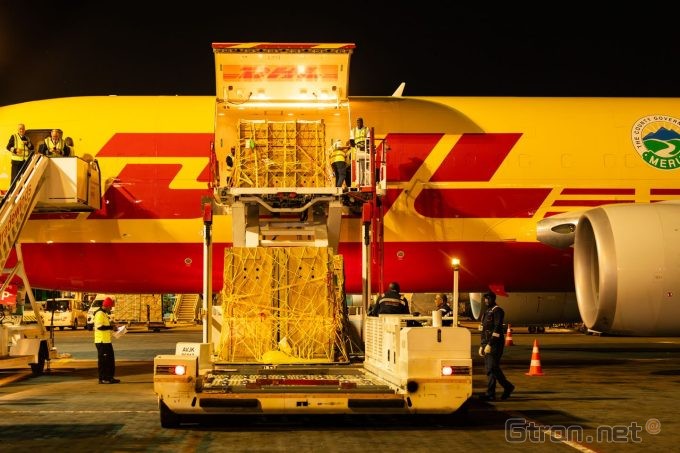
At its latest Middle East "navigating disruption" webinar, DHL unveiled plans to deploy a B777 freighter on a Leipzig-Dubai-Hong Kong routing, operating five times weekly contingent on security conditions . The service restoration follows the April 8 reopening of airspace in Syria, Iraq, and Bahrain after a US-Iran ceasefire agreement took effect .
"With Dubai, we will have three connections into the Middle East, the others being in Riyadh and Muscat in Oman," said Paul Dowling, DHL Express' customer operations manager for Middle East & North Africa. The Dubai flights will alleviate pressure on Riyadh and Muscat, which have served as backup hubs since hostilities began in late February .
DHL is also now serving Jeddah from Liège with a thrice-weekly B747-400F service dedicated to pharmaceutical and life science shipments. "We will continue with the Riyadh and Muscat operations, certainly until the end of April and until we see how the situation in the region evolves," Dowling added .
The reopening of commercial airspace in Iraq and Bahrain—where DHL Express maintains its MENA regional hub—has enabled improved connectivity. "We were able to utilise a commercial flight yesterday from Erbil to Dubai and from today we'll have a Fly Dubai option connecting Dubai into Erbil, so that will certainly improve the transit times into Iraq," Dowling noted .
However, the recovery trajectory is proving uneven. Patrick Bongers, DHL Global Forwarding's global head of airfreight growth, presented data showing that while Gulf carriers staged a gradual operational recovery last month, "this recovery has stalled over the last couple of weeks" .
Current data underscores the stagnation. Gulf airports are operating at approximately 51% of pre-crisis air freight capacity on average . Flightradar24's Gulf Airline Recovery Index shows Emirates and Etihad at roughly 70% of baseline capacity, while Qatar Airways and Air Arabia remain near 50% and flydubai slightly above 40% . Overall, Gulf airlines are collectively operating at approximately 52% of pre-conflict flight volumes .
The disparity is particularly acute at specific hubs. While Jeddah and Muscat have seen capacity utilisation surge by more than 100%—creating ground handling pressures—Dubai's cargo airport (DWC) continues to operate at just 38% of capacity .
"Emirates is up to about 80% capacity and Qatar Airways and Fly Dubai and other carriers from the region are beginning to follow," Dowling observed. "While we still have limited uplift, given the fact that international carriers are not returning into the Middle East and have no plans to do so anytime soon, I think the good news is that in the past week, we've seen an increase in capacity and flights" .
Xeneta chief airfreight officer Niall van de Wouw cautioned that full recovery could take months despite the ceasefire. "Even when it is deemed safe to fly, setting up the infrastructure again takes time. Customers need to find you again and trust you again. Insurance companies may still advise against transiting these Middle East hubs despite the ceasefire," he noted .
Air cargo rates remain elevated across affected trade lanes. Spot rates on the South Asia to Europe corridor are up 105% year-on-year, while Europe to Middle East rates have risen 87%, and South Asia to North America rates have increased 82% . Jet fuel prices, which have more than doubled since the disruption began, continue to constrain operations—accounting for approximately 27% of airline operating costs .
"Bahrain Airport is slowly getting back to operational capacity, but at this point, I can't put a date on when we will be uploading our flights from this hub again," Dowling acknowledged. DHL is exploring capacity on Gulf Air flights from Bahrain into Europe that could return this week .
The cautious approach reflects broader industry sentiment. International carriers including Air France, KLM, Lufthansa, and Cathay Pacific have extended flight suspensions to Middle Eastern destinations through May and June 2026 . More than 5.4 million seats and 18,000 flights have been cancelled by Gulf carriers for April alone .


