


The global shipping landscape in early 2026 remains a study in contrast, defined by geopolitical instability and a cooling freight market. French shipping giant CMA CGM’s latest first-quarter financial report serves as a bellwether for the industry, highlighting a significant pivot: as traditional maritime profits face a sharp correction, the company’s aggressive expansion into logistics and terminal operations is proving to be its most vital lifeline.
A Mixed Performance in a Softening Market
According to the results released today, CMA CGM reported a first-quarter volume of 5.93 million TEUs, a modest 1.5% increase year-on-year. While any growth in a turbulent environment is noteworthy, the figure suggests a loss in market share. With global container trade growing at a rate of 4.4% during the same period—according to Container Trades Statistics (CTS)—CMA CGM appears to be trailing its competitors in volume recovery.
The financial toll of lower freight rates was evident. The group’s maritime revenue fell 8.5% to $8.02 billion, while EBITDA for the shipping segment plummeted by 41.3% to $1.39 billion. This decline was primarily driven by a nearly 10% drop in average freight rates, which settled at $1,351 per TEU. This "normalization" of rates follows the extreme highs of previous years, but it has been exacerbated by an influx of new vessel capacity hitting the water across the industry.
The "Logistics Buffer"
Despite the maritime slump, CMA CGM’s overall group revenue remained remarkably stable at $13.2 billion, down only a negligible 0.2% compared to Q1 2025. This stability is the direct result of CEO Rodolphe Saade’s long-term vision to transform the carrier into an end-to-end integrated logistics provider.
Ceva Logistics, the group’s logistics arm, reported a 6.6% increase in revenue to $4.6 billion. While the subsidiary faced its own pressures in the automotive sector and freight management, its steady contribution helped cushion the blow from the shipping side.
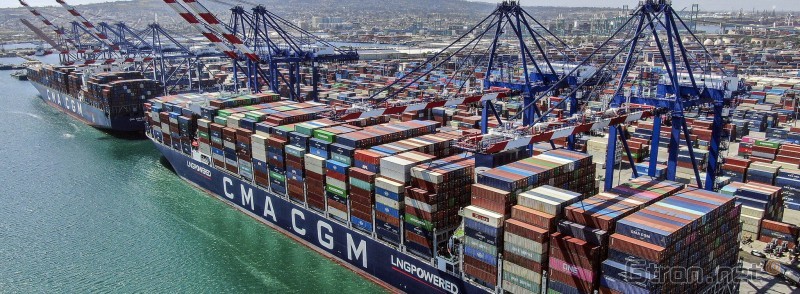
Furthermore, the "other activities" segment—which includes the company’s growing portfolio of port terminals and air cargo—saw a staggering 59.1% jump in revenue to $1.3 billion. The 90% surge in EBITDA for this segment underscores a strategic reality: owning the infrastructure (terminals) and diversifying the mode of transport (air cargo) provides a high-margin hedge against the volatility of ocean freight.
Geopolitical Pressures and Tactical Agility
The backdrop of these results is a world of persistent supply chain disruptions. Tensions in the Middle East, particularly affecting the Red Sea and Suez Canal transits, have forced carriers to maintain costly diversions around the Cape of Good Hope.
Rodolphe Saade emphasized that the group’s "resilient performance" was a byproduct of being able to pivot quickly. "We adjusted our network, implemented alternative logistics corridors, and maintained reliable service," Saade noted. This agility has become a prerequisite for survival in 2026, as environmental regulations (such as the expansion of the EU Emissions Trading System) and regional conflicts add layers of complexity to operational costs.
Looking Ahead: Agility as the New Currency
As CMA CGM moves further into 2026, the company faces a delicate balancing act. While the shipping market struggles with a "high comparison base" from 2025 and a less favorable supply-demand balance, the group’s non-maritime assets are no longer just "add-ons"—they are the core engines of stability.
The industry is watching closely to see if CMA CGM’s competitors follow a similar path of heavy diversification or if they will double down on "pure-play" shipping. For now, Saade’s strategy of building a multi-modal fortress seems to be the only thing keeping the headwinds from turning into a full-blown storm. As Saade concluded, the priority remains "managing risks with discipline and preserving the group’s agility." In an era of "permacrisis," agility may well be more valuable than market share.


