


Global Maritime Industry - While the chaotic disruptions of the pandemic era may be in the rearview mirror for container shipping, a stark new reality has emerged: unreliability has become the "new normal." Fresh data from maritime intelligence firm Sea-Intelligence reveals that 2025 marked a definitive consolidation of diminished service standards, effectively normalizing schedule reliability far below historical benchmarks.
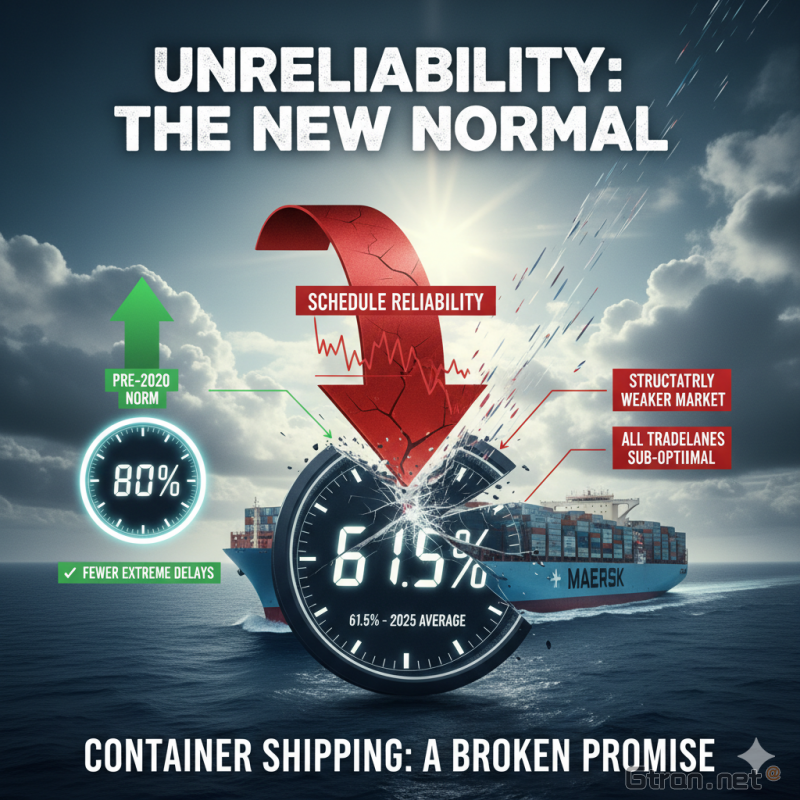
"2025 remains well below the 70%-80% reliability band that defined the market prior to 2020," stated Sea-Intelligence, painting a sobering picture for shippers worldwide. Despite an 8.5 percentage point improvement from the 2024 low, global average schedule reliability only reached 61.5% last year – a performance that ranks a dismal 11th out of 14 years in Sea-Intelligence's extensive dataset. This signifies a market structurally weaker than its pre-2020 norm, exchanging extreme disruptions for a constant state of "manageable, short-term" delays.
A Year of Underperformance and Stalled Recovery:
The year began with a troubling "deep underperformance." January 2025 saw reliability plummet to just 51.4%, mirroring the instability of post-2020 lows. "Early 2025 operations were nearly indistinguishable from the unstable baseline," analysts noted, indicating a severe hangover from previous years' chaos.
Momentum did pick up in Q2, with schedule reliability jumping 7.4 percentage points between April and May. However, even in its strongest months later in the year, 2025 never climbed higher than ninth in historical rankings. "The network stabilised, but lacked the fluidity to challenge established historical highs," Sea-Intelligence concluded, highlighting a persistent inability to return to peak efficiency.
Average delays for all vessel arrivals in 2025 fell to 1.58 days, an improvement from 2.21 days in 2024. Yet, this figure remains significantly above the pre-2019 averages of under 1.2 days, placing 2025 at 10th out of 14 years for delay performance.
Trading Extreme Disruptions for Frequent Minor Ones:
Perhaps the only silver lining is a shift in the nature of delays. In 2025, 43% of late arrivals were delayed by a more manageable two to three days, a 3% increase year-on-year. Crucially, extreme delays of more than 12 days dropped from 6% in 2024 to 4% in 2025. "The market is effectively trading ‘extreme, multi-week disruptions’ for ‘manageable, short-term’ ones," the report summarized, suggesting a frustrating but less catastrophic environment for supply chain managers.
Maersk and Hapag-Lloyd Set New (Lower) Ceiling:
In this landscape of widespread mediocrity, only Maersk and Hapag-Lloyd, partners in the upcoming Gemini Cooperation, managed to post median reliability above 70%. Maersk, in particular, set the operational ceiling with an average of 72.9% on-time arrivals and a peak monthly score of 80.9%, positioning themselves as industry leaders in a market struggling for consistency.
A "Sub-Optimal Year" Across All Trade Lanes:
Tragically, 2025 was "universally a sub-optimal year, by historical standards," across all trade lanes. Not a single major route achieved a schedule reliability rank higher than fourth, meaning that on every single major tradelane, there have been at least four other years in the past decade with better schedule reliability. Even the best relative performers, Oceania-North America and Asia-North America West Coast, only managed median performances, failing to herald a true return to efficiency.
"2025 avoided pandemic-era lows, but it remains structurally weaker than the pre-2020 norm," Sea-Intelligence concluded. For businesses relying on global supply chains, this means a recalibration of expectations is essential, as persistent unreliability appears to be an entrenched feature of the modern container shipping landscape. Navigating this "new normal" will require heightened agility, robust contingency planning, and a pragmatic acceptance of diminished service levels.


