


Global Shipping Market – Africa is emerging as a dominant force in global container trade, with carriers significantly boosting capacity to meet escalating import and export demands. Hailed as "by far" one of the fastest-growing markets alongside the Middle East and South Asia, Sub-Saharan Africa is attracting substantial investment and fleet deployment from major shipping lines.
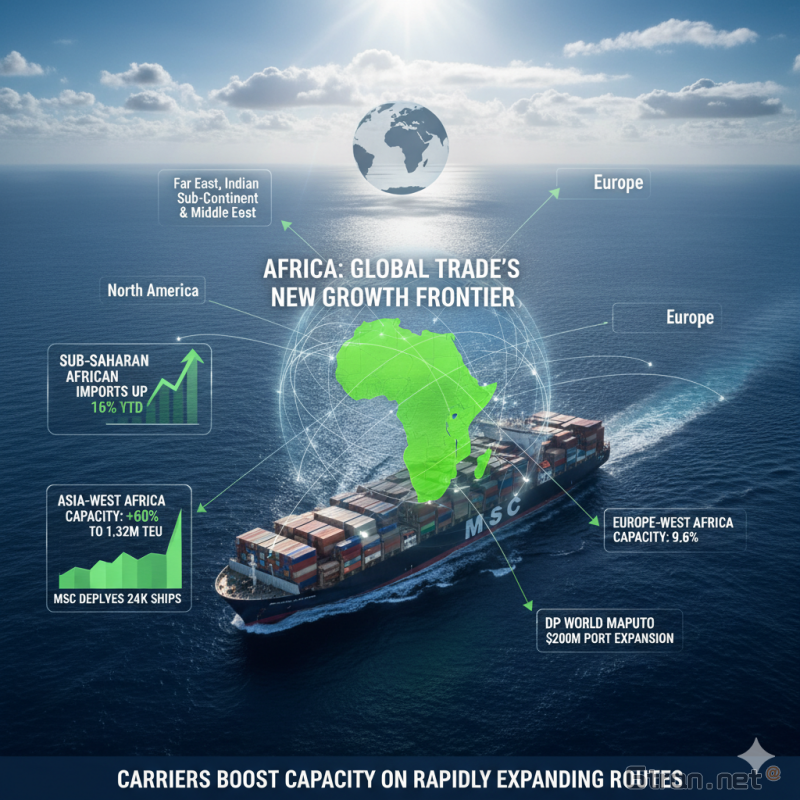
Recent data from CTS highlights that Sub-Saharan African imports have surged by an impressive 16% year-to-date (YTD) in October. This growth is predominantly driven by robust cargo flows from the Far East, Indian Sub-Continent & Middle East, and, surprisingly, a strong uptick from North America. This surge reflects a strategic reorientation by major export markets, seeking new channels amidst declining demand from traditional consumer giants like the US.
Shipping analysis reveals that out of the 7.3% global container fleet growth (equating to 2.27 million additional TEU) over the past 12 months, a significant 575,410 TEU has been deployed specifically on liner services to and from Sub-Saharan Africa. This demonstrates carriers' proactive response to the burgeoning market.
"The main conclusion of our latest global fleet deployment survey is that Africa and Middle East/India Subcontinent are now by far the fastest-growing markets," stated a leading analyst. "For Africa-related services, the impressive 27.3% capacity growth is clearly related to the Asia-Africa segment."
The fleet deployed between Asia and West Africa alone reached 1.32 million TEU last month, marking a substantial increase of 494,800 TEU, or 60% more than in November last year. When including South-east Asia to East & South Africa capacity, the total trade route now accounts for nearly 2.2 million TEU, up from 1.4 million TEU a year ago, representing a staggering 54.3% increase.
A significant portion of this capacity boom can be attributed to MSC, the world's largest carrier. In February, MSC strategically upgraded its Asia-West Africa Africa Express service, replacing its fleet of 14,000 to 16,000 TEU vessels with larger 24,000 TEU Megamax ships. This move underscores the long-term commitment and confidence in the African market's potential.
Infrastructure development is also key to supporting this growth. In a recent interview, Mohammed Akoojee, CEO & MD of DP World Sub-Saharan Africa, revealed DP World's plans to develop and expand its East African terminals. This includes a substantial $200 million investment to deepen the berth in Maputo, Mozambique, enabling it to accommodate similar larger vessels. "It is important because East Africa is very well connected to markets in the Middle East, India, and Asia," Akoojee explained, highlighting ambitions for Maputo to become a crucial African logistics hub for regions like Zimbabwe, South Africa, and Zambia.
Beyond the dominant Asia-Africa corridor, the Europe-West Africa trade also experienced notable growth. Capacity on this route in November increased by approximately 29,800 TEU, or 9.6% year-on-year, reaching 338,760 TEU.
Collectively, all Sub-Sahara-related African services now account for a substantial 8.1% of the overall world container fleet, totaling 2.68 million TEU. This aggressive capacity deployment and strategic infrastructure investment signal Africa's rising importance as a global trade and logistics powerhouse, reshaping international shipping patterns for years to come.


