


Seoul, South Korea - Ocean-going liner operators are facing a prolonged period of severe overcapacity and depressed freight rates, a challenging market environment that could persist for years, potentially until 2030. This grim outlook comes from a recent report by Yang Jong-seo, a researcher at the Export-import Bank of Korea, who highlights the compounding issue of minimal vessel scrapping as new tonnage floods the market.
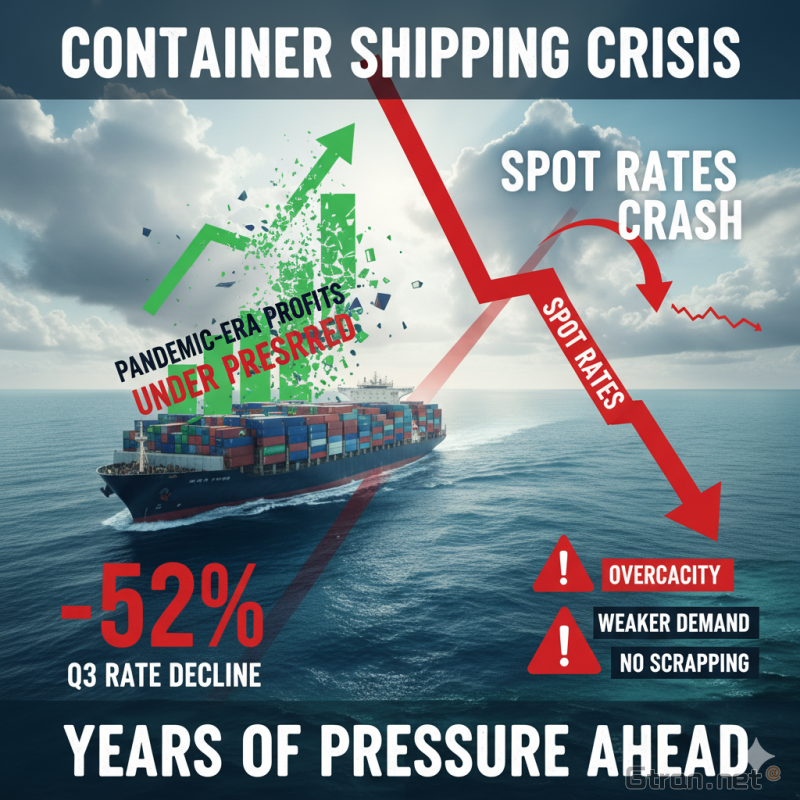
According to Mr. Yang, the container shipping industry, after experiencing unprecedented booms fueled by the COVID-19 pandemic and subsequent Red Sea diversions around the Cape of Good Hope, is now entering a sustained down cycle. Freight rates, which saw temporary upticks in Q3 2025 due to US tariffs, rapidly declined thereafter, largely due to a record influx of newbuilding deliveries.
Evidence of this decline is starkly visible in key indices. The Shanghai Containerized Freight Index (SCFI) and China Containerized Freight Index (CCFI) barely surpassed 1,000 points, reaching 1,115 and 1,087 points respectively. Average freight rates in Q3 registered significant year-on-year drops of 52% for the SCFI and 40% for the CCFI.
Specific trade lanes show even more dramatic reductions. Rates on the Shanghai-North Europe route sharply declined from their 2024 average of $1,680 per TEU to just $971 by the end of September. Similarly, the Shanghai-US West Coast rate fell from an average of $1,948 per 40ft to $1,468, while the Shanghai-US East Coast rate dropped from $3,133 per 40ft to $2,452.
The Challenge of Scrapping:
To restore market equilibrium, shipping consultancy Dynamar recently estimated that as many as nine million TEU of vessel capacity would need to be scrapped. However, Mr. Yang cautions that such massive demolition is easier said than done, primarily because the bulk of the overcapacity comes from relatively new, large vessels.
"The severity of the situation is heightened by the fact that a significant volume of new vessel deliveries is scheduled for a considerable period of time, and the large vessels typically deployed on ocean routes, vessels of 12,000 TEU and above, are all young, making supply adjustments through scrapping impossible," Mr. Yang stated in his report. He further noted that "not a single container ship over 12,000 TEU has been scrapped yet."
Projecting an average annual growth rate of 5% in global fleet capacity through 2028, Mr. Yang specifically highlighted that the number of ships exceeding 12,000 TEU is expected to increase by more than 12% annually. This disproportionate growth in mega-vessels will significantly exacerbate the slump on major ocean routes.
Potential for "Catastrophic" Deterioration:
Adding another layer of concern, Mr. Yang warned that a resolution to the Red Sea crisis and the resumption of normal Suez Canal transits could further depress the ocean-going market to "catastrophic" levels. The current rerouting around the Cape of Good Hope temporarily absorbs some capacity due to longer transit times, but removing this factor would immediately inject more available tonnage back into the market.
To pre-empt this severe market correction, Mr. Yang suggested that mainline operators should proactively adjust their vessel deployment within their alliances. He also recommended diversifying shipping routes, strategies that could collectively reduce effective supply and potentially increase demand by optimizing service offerings. Without such proactive measures, the container shipping industry appears poised for a challenging and prolonged downturn.


