


Copenhagen / Schindellegi, Switzerland - The world's two leading freight forwarders, DSV and Kuehne + Nagel (K+N), today unveiled their third-quarter results, painting a picture of a sector undergoing profound restructuring within an increasingly challenging market. While DSV showcased significant growth driven by its recent acquisition, K+N faced headwinds, leading to a downward revision of its full-year outlook and the announcement of a substantial cost-cutting program.
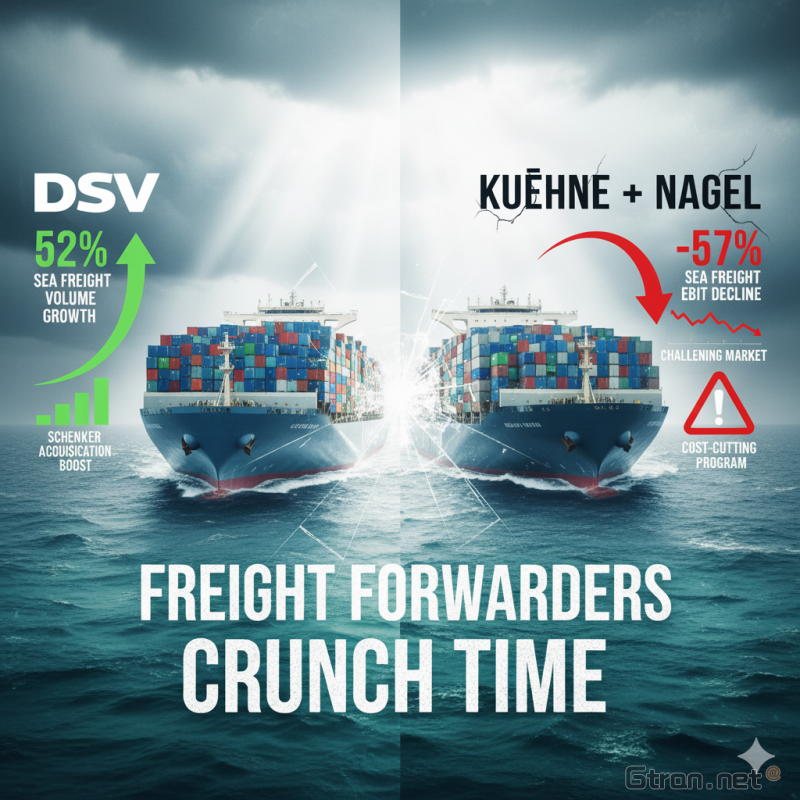
DSV's Q3 results reflected the first full quarterly impact of its acquisition of Schenker's business. The Danish logistics giant reported a remarkable 52% year-on-year increase in sea freight volumes. However, management clarified that DSV's organic volumes, excluding the Schenker contribution, were down 5% compared to the same period last year. Despite this robust growth, Kuehne + Nagel managed to narrowly retain its position as the largest sea freight forwarder, moving 1.1 million TEUs in Q3, just surpassing DSV's combined 1.07 million TEUs. DSV's ocean freight activities generated a gross profit of Dkr4.4bn ($683m), with Schenker contributing Dkr1.3bn to this figure.
DSV CEO Jens Lund acknowledged the increasing market uncertainty, stating, "It's crunch time." In air freight forwarding, DSV's volumes surged by 64% year-on-year, reaching 579,000 tonnes. While organic volumes saw a slight dip due to the "exit of low-yielding volume," the overall growth underscored the impact of the Schenker integration. Both DSV's road freight and contract logistics divisions also experienced positive effects from the acquisition. Road freight reported a significantly higher EBIT of Dkr798m compared to Dkr514m last year, despite "organic earnings remaining lower." Contract logistics saw its EBIT almost double to Dkr1.1bn. DSV attributed this performance to Schenker's positive contribution to earnings growth, coupled with improved organic earnings driven by "commercial initiatives leading to higher utilization and a continued focus on cost efficiency."
The group-wide revenues for DSV soared to just under Dkr72bn, up from Dkr44.1bn a year prior, while EBIT increased to Dkr5.4bn from Dkr4.4bn. DSV largely maintained its full-year EBIT outlook of between Dkr19.5bn and Dkr20.5bn, with EBIT for the first nine months of 2025 standing at Dkr14bn.
In contrast, Kuehne + Nagel downgraded its full-year EBIT outlook from CHF1.45bn-CHF1.65bn to CHF1.3bn ($1.63bn) following a challenging quarter. Its sea freight division experienced a significant 57% year-on-year EBIT decline, and air freight forwarding saw a 23% drop. While sea freight volumes remained flat at 1.1 million TEUs, K+N did record a 7% gain in air freight tonnage, reaching 564,000 tonnes.
K+N's road freight operations witnessed a 9% decline in EBIT despite a 3% increase in revenues, as weak demand and overcapacity continued to plague the European road freight market. The contract logistics division saw both EBIT and revenue rise by single-digit percentages year-on-year. Group-wide revenues for K+N increased by 3% year-on-year to CHF18.5bn, but EBIT contracted by 17% to CHF1.03bn. In response to these challenges, K+N announced a new cost-cutting program aimed at saving approximately CHF200m.
"With the launch of group-wide cost reduction measures, we are now taking action to safeguard our cost base," said K+N CEO Stefan Paul. "Challenging external factors are forcing us to sustainably and permanently improve our efficiency and performance culture." According to an analysis by investment bank Jefferies, the cost-cutting measures will include CHF110m from job losses, CHF50m from facilities, and the remaining CHF40m from "others." The program is anticipated to be completed by the end of 2026 and is expected to incur around CHF50m in restructuring costs over Q4 of this year and Q1 of 2026. The diverging fortunes of these industry titans underscore the dynamic and increasingly competitive landscape of global freight forwarding.


