


Air cargo capacity between Asia and Europe has fallen sharply after several Gulf airspace zones and major aviation hubs were forced to suspend operations due to escalating tensions in the Middle East. The sudden disruption has removed a significant portion of global cargo transit capacity and is beginning to push freight rates higher.
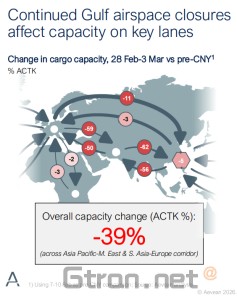
Industry analysis indicates that air cargo capacity across key trade corridors linking the Asia-Pacific region, the Middle East, and Europe has dropped by nearly 40 percent in available cargo tonne kilometres (ACTK). The decline is measured against typical pre–Chinese New Year operating levels, which are commonly used as a benchmark for stable market conditions.
A major factor behind the contraction is the temporary shutdown or restriction of airspace surrounding some of the world’s most important cargo transfer hubs in the Gulf region. Airports in cities such as Doha, Dubai, and Abu Dhabi serve as critical connection points for long-haul freight moving between Asia and Europe. When airlines lost access to these hubs, many flights were either cancelled or forced to take longer alternative routes.
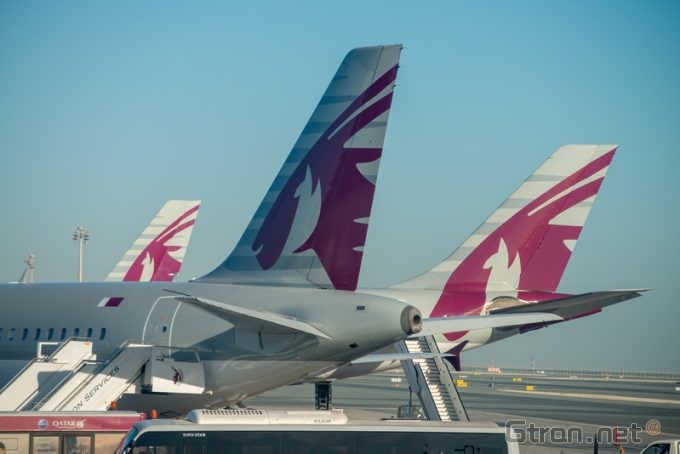
The disruption is amplified by the central role Gulf-based carriers play in the global air cargo network. Airlines including Qatar Airways Cargo, Emirates SkyCargo, and Etihad Cargo collectively contribute a substantial share of worldwide freight capacity. Their hub-and-spoke networks allow cargo from Asia, Africa, and Europe to be consolidated and redistributed efficiently through the Gulf.
Under normal circumstances, a significant share of air freight traveling between China and Europe passes through Middle Eastern hubs. Industry estimates suggest that roughly one quarter of that traffic relies on transit points in the region. As a result, the sudden loss of these gateways is affecting logistics flows far beyond the Middle East itself.
Airlines have begun adjusting their strategies to maintain connectivity. Some carriers are increasing the number of direct long-haul cargo flights between Asia and Europe to bypass restricted airspace and avoid Gulf stopovers. Data shows that direct capacity on certain Asia–Europe routes has grown by roughly 13 to 14 percent as airlines deploy aircraft capable of longer non-stop operations.
However, direct flights alone cannot fully compensate for the flexibility and connectivity offered by traditional Gulf hub networks. Those hubs allow cargo from multiple origins to be consolidated before moving onward, a structure that is difficult to replicate through point-to-point services. As a result, gaps in available cargo capacity remain.
The impact is especially severe for exporters in South and Southeast Asia. Many shipments from these regions rely on Middle Eastern transit hubs before continuing to European destinations. With those routes disrupted, logistics providers are facing delays, tighter space availability, and the need to quickly identify alternative transport options.
Regional capacity losses highlight the scale of the disruption. Cargo lift within the Gulf region has dropped dramatically, while South Asia has also seen significant declines. Parts of the eastern Mediterranean and surrounding regions have experienced notable reductions as well.
The tightening supply is already beginning to influence market pricing. Recent air freight index data shows moderate but noticeable increases on several major trade lanes. Rates for shipments from China to Northern Europe and North America have risen slightly, while transatlantic cargo prices have also edged upward.
Although the increases remain relatively limited for now, industry analysts warn that prolonged airspace restrictions could lead to greater volatility in the global air cargo market. Reduced capacity, longer flight paths, and network restructuring could all place additional pressure on shipping costs.
For airlines and freight forwarders, the immediate priority is operational adaptation. Carriers must reroute aircraft, reposition cargo that was originally scheduled through Gulf hubs, and redesign flight networks to accommodate restricted airspace. If the disruption persists, these adjustments could reshape established air freight routes between Asia, the Middle East, and Europe.


