


Liner operators’ results in H1 25 clearly show that intra-Asia ocean carriers have been the most resilient amid the tariff turmoil.
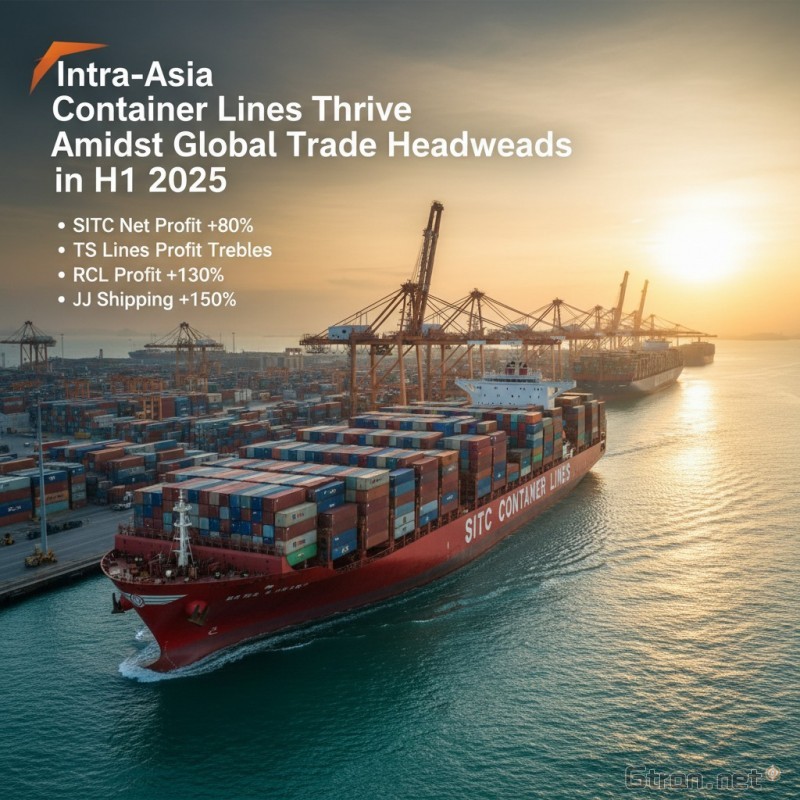
Hong Kong-based SITC International Holdings, parent of SITC Container Lines, achieved a net profit of $633.45m, up 80% on H1 24.
Chairman Yang Xianxiang attributed the higher earnings to a higher volume of containers carried by SITC, 1.83m teu, compared with 1.7m teu a year ago.
Average freight rates also increased, by approximately 23%, on H1 24, to $776.40/teu.
SITC's management predicted that intra-Asia trade would continue growing, even as long-haul trade tanks amid US trade tensions and import sources and slowing economic growth in the western world.
Drewry previously estimated intra-Asia trade was growing at over 3% annually, compared withj less than 1% for long-haul trade.
Mr Yang said: “With the evolving global trade landscape, regional trade has become increasingly frequent, driving a growing demand for flexible and efficient small container vessels. On the other hand, the aging issue of small container vessels has gradually become prominent.
“SITC is closely monitoring the supply and demand relationship of the industry and adjusting the fleet structure accordingly to reduce emissions, with full confidence in achieving sustainable development.”
Compatriot TS Lines saw its net profit treble, to $188.82m in H1. Primarily an intra-Asia carrier, it has a transpacific and a Far East-Mexico service. The Asia-Pacific region accounted for 83% of its revenue.
Chairman Chen Teh-sheng said the higher earnings had been primarily driven by strong performance on the Greater China-South-east Asia and Greater China-North-east Asia markets, both of which recorded notable improvements in unit revenue, reaching an average freight rate of $611 and $514 per teu, respectively.
During the first six months, TS Lines shipped 818,480 teu, a slight decrease on the same period in 2024, mainly reflecting slot adjustments on some short-haul regional services.
Regional Container Lines’ net profit in H1 25 surged 130% from the year-ago period, to THB4.06bn ($124.35m), driven by a 28% increase in freight income.Volumes were up 12.2%, to 144,000 teu. The Thai operator supplements its revenue by being a tonnage provider, with some large ships chartered to mainline operators.
Finally, Shanghai International Port Group’s liner operating subsidiary, Shanghai Jin Jiang Shipping (JJ Shipping), reported a net profit of CNY794m ($111m) in H1, a 150% year-on-year jump, with 1.3m teu carried during the period.
JJ Shipping said it expanded into emerging markets, launching routes connecting China and South Korea with the Indian subcontinent. And describing South-east Asia as a growth engine, it said it had set up a joint-venture 3PL in Vietnam and started intermodal services in Cambodia.
Now ranked 35th among liner operators, JJ Shipping operates 53 ships, with a total capacity of 58,000 teu, 6,000 teu more than last year.
The company plans to add to its fleet, and is inviting tenders from Chinese shipbuilders to construct two 1,100 teu ships, with options for another two.
Linerlytica said in its report last week that the shortage of charter tonnage and relatively small orderbook in the feeder sector had shielded the intra-Asia carriers from the severe rate-cutting now appearing on the long-haul tradelanes; but it remains to be seen if the respite lasts until the end of the year.


